What is the Crab Creek Watershed?
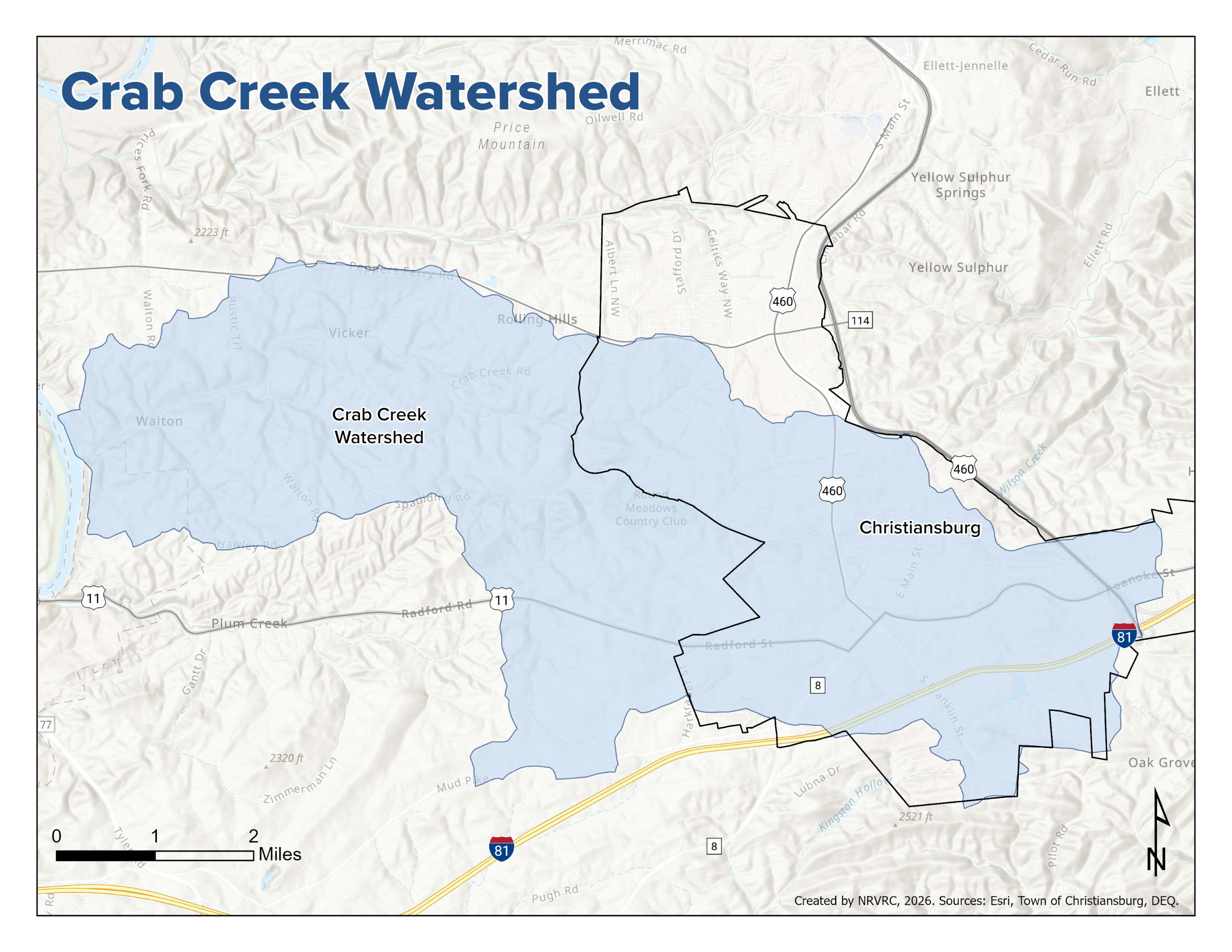
The Crab Creek Watershed is the area of land in which all run-off and rainwater drain into Crab Creek. Think of it this way. Rain water and run-off are constantly moving from a higher point to a lower point, due to the laws of gravity. In our mountain terrain this often means that a rain drop falling on one side of the highest ridge point will make its way to a lower elevation point in a completely different stream, body of water or aquifer than a drop of rain falling on the other side of the same ridge. If we were to draw a line, connecting the dots between all of these highest ridge points, we would eventually create an enclosed boundary where all rain water that falls within this area makes its way to a specifically measurable low point. The particular low point we are interested in here is where Crab Creek enters the New River. If we pick a point farther downstream on the New River, the watershed boundary would increase to include exponentially more area, covering a portion of what is known as the New River Watershed. That's right! The Crab Creek Watershed is a part of the larger New River Watershed and plays a critical role in maintaining the health and ecosystem services of the New River!
What is Wrong with Crab Creek?
Unfortunately over time and under improper conditions watersheds can become impaired, but what is an “impaired” watershed? A healthy watershed functions as a natural rainwater filter, supports wildlife, reduces flooding, replenishes aquifers and ground water reservoirs, among other things. When a watershed becomes polluted, these natural processes become less effective, reducing the watershed's ability to filter pollutants, support wildlife, protect water quality, and remain resilient during storms.
We’ve all heard about major chemical spills or improper disposal into streams and rivers, but this in and of itself is not the major problem causing the impairment of the Crab Creek Watershed. In 2004 the Crab Creek Total Maximum Daily Load (TMDL) study was prepared for the Virginia Department of Environmental Quality (VADEQ). The purpose of this report was to investigate why Crab Creek was not meeting Virginia’s water quality standards and identify what needed to take place to restore the stream and maintain its ecological function. This report revealed two critical areas as the primary causes of impairment - Excess bacteria (fecal coliform/E. Coli and Excess sediment. These two factors made portions of Crab Creek unsuitable for recreation and contributed to the declining habitat of aquatic species and disruption of the natural system functions.
Read the Full Report Here:
What Can I Do To Help?
The Crab Creek Watershed impairment was not an overnight process and unlike many impaired watersheds around our nation is not attributed to one major pollution source. Rather the impairment of the watershed comes mainly due to a collection of smaller activities such as urban stormwater run-off, streambank erosion and increased impervious areas. With this in mind there are several ways in which we can help restore and maintain the daily function of the watershed through our daily activities and by participating in the Crab Creek Beautification Phase II Cost Share Program.
Every Day Practices
The small things really make a big difference. To do our part daily we can:
- Pick-up after ourselves and our pets to make sure all trash finds its way to appropriate receptacles
- Ask ourselves is this amount of paving really necessary? Before adding that new sidewalk or driveway
- Find time to plant a native perennial, shrub or tree. Native plants reduce reliance on inputs and help filter water before it heads on to crab creek.
- Avoid pouring chemicals and other waste materials into storm drains
- Use lawn and garden fertilizer sparingly
- Much more,,,,,,
A more comprehensive list of daily habits can be found at: