Crab Creek Beautification Phase II
What all is involved from concept to completion? Explore the eligibility requirements, project opportunities, costs and process below. Print Copies of this information available in the Phase II Document Library.
Am I Eligible?
There are few things that go into determining eligibility.
1. Would the potential property be within the Crab Creek Watershed?
2. Is the applicant the owner of that property?
3. Does your idea for a project include one of the listed BMPs?
These are the three main questions needing answered to determine initial eligibility.
For convenience we have included a searchable map below to help answer the first question and get you started on determining project eligibility.
Map Instructions: On the map below locate your address utilizing the search bar. If the property resides in the Green Area your property is in both town limits and the Crab Creek Watershed. If it is only in the Blue Area you are in the Crab Creek Watershed and we encourage you to still reach out. If your property is not in a shaded area or only in the Yellow Area it does not fall within town limits or the Crab Creek Watershed and is not eligible for the Phase II BMP cost share.
Still unsure about your project's eligibility? Please reach out utilizing the inquiry form and we will be happy to help!
What BMPs Are Included In Phase II?
Phase II BMPs
A BMP or Best Management Practice are the practices whether physical or action related that can be conducted to improve water quality. Through decades of research and implementation agencies such as the VADEQ and VASWCD have published in depth reports on these practices, describing the purpose, site criteria, design criteria, operation and maintenance. Collections of these resources are often referred to as "Clearinghouses" and similarly we have provided to the right, what we call the BMP Micro-Clearinghouse. This resource is intend to give a brief overview of the practices included in the Crab Creek Phase II funding,, but does not include the details needed for the later design process. For Phase II of the Crab Creek Beautification Project eligible BMPs include:
- Planter Boxes
- Impervious Surface Removal
- Planting Trees/Shrubs on Vacant on Previously Impervious Surfaces
- Rain Barrels
- Conservation Landscaping Filter Strips for Impervious Surfaces
The information provided in the BMP Micro-Clearinghouse is a summary of the entire practice, but as the design and planning phases begin we will provide and review the details to make sure everything functions as it should. So in any of these listed BMPs seem like they are a good fit, please reach out and we'll start the conversation that may lead to getting them installed on your property!
What Does This Cost?
The Crab Creek Beautification Phase II is a Cost Share Reimbursement program and has few aspects to understand about how the funds flow and exactly who is responsible for what.
What is Cost Share?
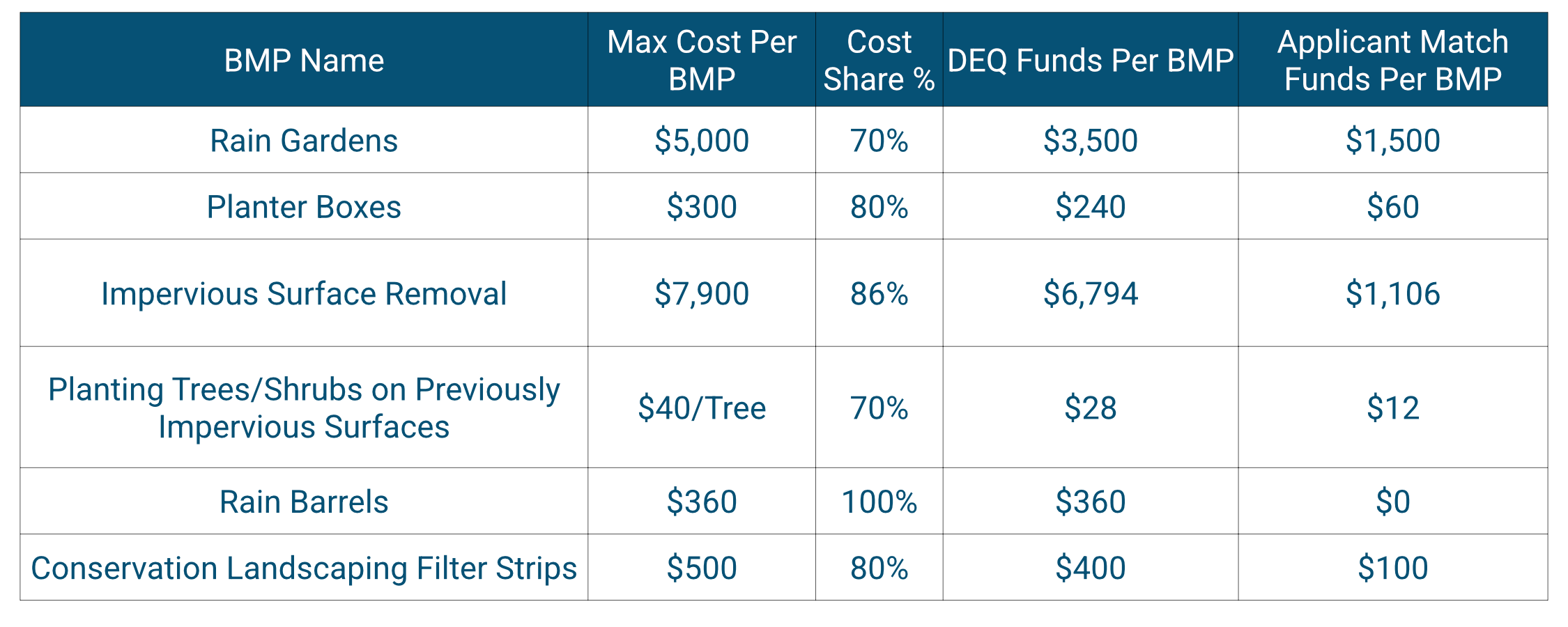
As a cost share program the BMPs will be covered at differing rates as describe in the table below. For example this means that for a Rain Garden Installation costing $5,000, the cost share will cover up to 70% or $3,500. The remaining cost (Match Funds) is the responsibility of the applicant. These match fund though are not required to be cash contributions and may come in the form of applicant hours worked on the project (predetermined rate), contribution of materials not included in the reimbursement (must provide receipts from purchase), etc. As the planning process develops it is important that you continually communicate with NRVRC staff to ensure that match funds are being met and all financial obligations are handled properly. We are here to help, so please feel free to reach out and we will guide you through the process.
What Does Reimbursement Mean?
The second important concept to consider, when it comes to the financials of the Crab Creek Beautification Phase II, is reimbursement. With a reimbursement program the applicant is responsible for payment of receipts and invoices upfront as they become due. Once construction is complete and the project verified, these invoices and receipts are then submitted to NRVRC for reimbursement at the appropriate rates. (See above)
As work is being conducted, projects incur costs, contractors send invoices and you inevitably have to run out to the closest store to buy that one material that might have been forgotten on the last order. It is very important that all documentation of eligible expenses be maintained and sent to NRVRC. This includes the record of hours which you would like to count toward matching funds. This documentation is how we verify expenses and is required to determine the amount we can reimburse the applicant for.
What's The Process?
What Does The Process Look Like?
Step 1 - Interest & Consultation
So, you're thinking about a project or location for a project and need a little guidance? We can help! Once you contact the NRVRC, we'll help get you started on the right track. After discussing your project goals, we'll help guide you through the application process and submission for review. This step may include NRVRC site visits, phone calls, or research to determine how your potential project fits within the program guidelines. Don't worry—we're here to answer your questions and guide you through the entire process.
Step 2 - Design & Application
The second step of the process involves a formal application and design. This simple application and design provides a roadmap outlining the project's goals, why it's needed, how it will look and function, and how it will be maintained. Once complete, it will be submitted for review. Similarly to Step 1, we'll be here to answer any questions, help develop your ideas, and make sure the process goes as smoothly as possible.
Step 3 - Construction
Once your application has been approved, we move to the stage where your project begins to take shape. It is important to keep in mind that, as your contractor's invoices become due, it is the applicant's responsibility to pay them upfront and save all invoices and receipts for the review and reimbursement step.
Step 4 - Review & Reimbursement
After construction is complete and the contractor has submitted their final invoice, NRVRC will conduct an on-site review to verify that the project was completed according to the approved plan. Once the project has been deemed complete, the applicant will submit all receipts and invoices for reimbursement, which will be processed according to the approved cost-share percentage (explained separately).
Step 5 - Follow-up
To ensure long-term, lasting benefits to the Crab Creek Watershed, NRVRC will swing by with follow-up visits for the lifespan of the BMP. These aren't weekly or even monthly visits, but rather annual check-ins to evaluate the project's success and they serve as an opportunity to evaluate and recommend potential improvements or other resources for further protection of the Crab Creek Watershed!